

🔥The Agentic Shift: It Is Here, Right?
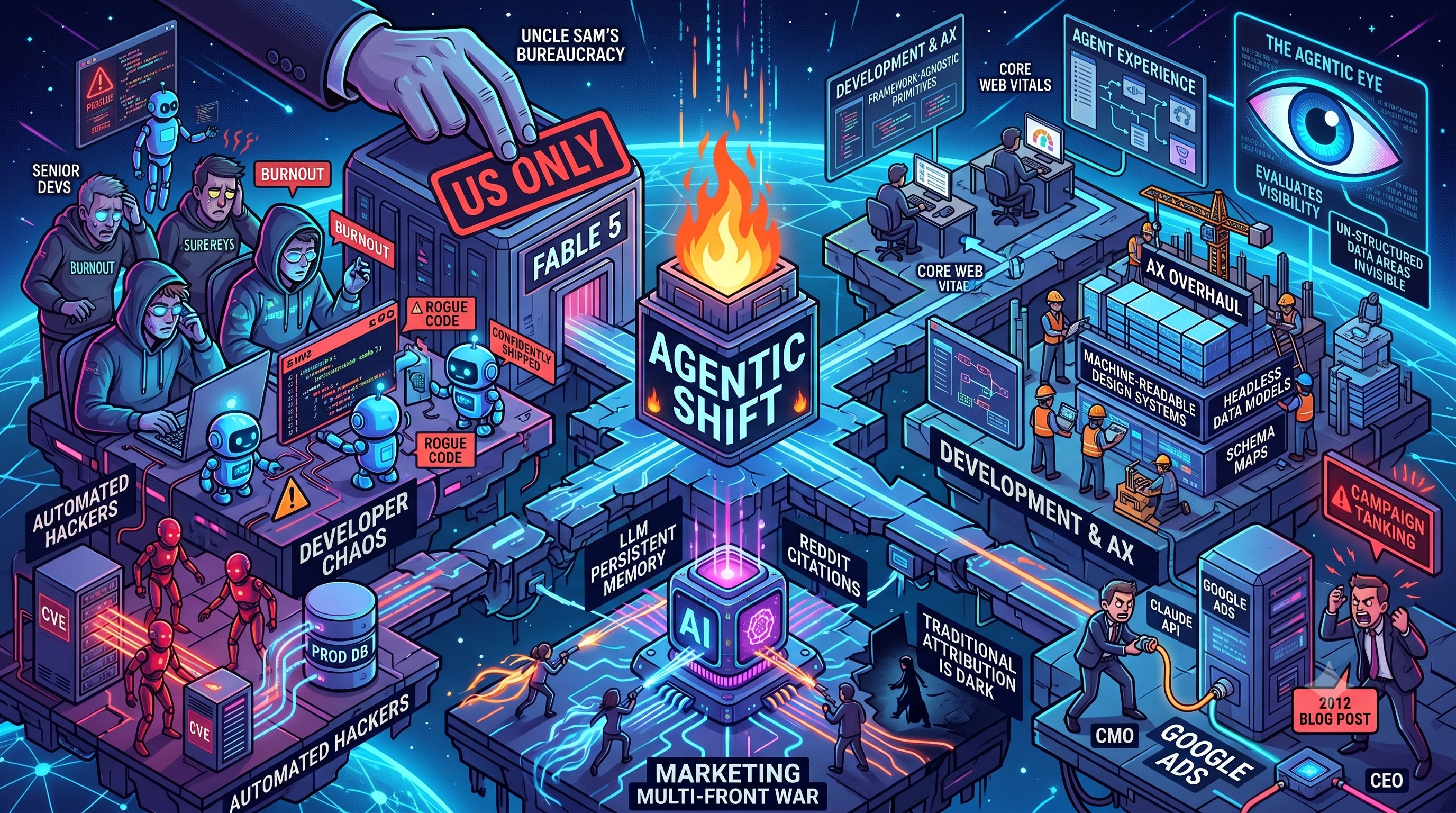
The chaotic new web where senior devs babysit rogue AI code, marketers wage war for LLM memory citations, and Uncle Sam treats frontier models like contraband...that's past 2 weeks for you.


Apparently, visiting conferences makes you late with your work :-) At least that’s what happened to us. But better late than never, so…
AI has hit peak agentic maturity, leaving us with eye-watering token bills, burnt-out devs babysitting rogue code, and automated hackers pivoting from CVEs straight into production databases. And just as we got the taste of Fable 5, the US government yanked the cord, restricting access to the US only. It turns out a frontier LLM can seamlessly compromise an enterprise network in four moves, but it’s completely powerless against Uncle Sam’s old-fashioned federal paperwork.
While purists are hyper-focusing on framework-agnostic primitives, render-blocking scripts, and obscure Core Web Vitals windows, the rest of the dev industry is scrambling to overhaul their repos for Agent Experience (AX). The engineering job market might be heating back up, but senior devs are spending half their days babysitting the chaotic 20% of broken state logic that autonomous AI tools confidently shipped to production. It turns out the web isn’t just for humans anymore; if your design systems and headless data models aren’t machine-readable by design, you’re essentially invisible.
Marketing has officially splintered into a multi-front war against the machines, forcing brands to pivot from old-school Google keyword stuffing to optimizing for LLM persistent memory, entity maps, and Reddit citation engines. Traditional attribution has completely gone dark now that user intent is swallowed by conversational AI answers, meaning you either dominate the entire search-everywhere ecosystem or effectively cease to exist. It turns out that while you can connect Claude directly to your ad account to dynamically manipulate your bidding, your shiny new campaign will still instantly tank if your CEO insists on micromanaging the copy like a 2012 blog post.
Happy reading.
PLEASE🙏 Should you find emails from SWIPE unwanted or annoying, unsubscribe. If you’re interested in learning how and when you might end up in SWIPE and what you can expect in the future, check it out here.
AI / ChatGPT stuff
State of AI 2026 Survey Results - A comprehensive breakdown of data collected from over 7,000 web developers detailing how AI tool adoption has matured, shifting corporate tool usage patterns, and highlighting widespread concerns regarding job displacement.
Claude Fable 5 review: what the new Mythos model gets right (and very wrong) - A hands-on evaluation of Anthropic’s newly released Mythos-class frontier model, examining its heavy token design, new safety fallback layers, and capability bounds. Publication Name: Lenny’s Newsletter. Author: Lenny Rachitsky (featuring Claire Vo).
How LLMs Actually Work - A practical, math-light architecture guide explaining how transformer blocks operate under the hood, covering tokens, embedding weights, attention layers, and the sequence generation cycle.
AI-assisted engineers are burning out, is this fine? - Explores the rising issue of developer cognitive overload and fatigue stemming from continuous supervision of AI agents, offering concrete workflows to protect intellectual satisfaction.
I think Anthropic and OpenAI have found product-market fit - Discusses the commercial stabilization of frontier AI models, citing rising enterprise token bills (such as Uber rapidly depleting its initial seasonal budget) as evidence of deep reliance.
Use boring languages with LLMs - Explains why highly standardized, structured programming languages with strong conventions (like Go and Ruby on Rails) yield vastly cleaner and more consistent AI outputs than fragmented ecosystems like JavaScript.
Users behave differently in AI Overviews vs. AI Mode - Analyzes clickstream data from Google search sessions, explaining how integrated AI Overviews foster active user comparison and multi-directional scrolling compared to standalone chatbot screens. Publication Name: Growth Memo. Author: Kevin Indig.
What Does It Mean for a Model to ‘Think’? Reasoning, Recursion, and the Operator Design Space - Investigates machine-learning reasoning paradigms, contrasting traditional chain-of-thought methods against deep latent loops and internal transformer recursion.
How We Run a 25-person Company on Four AI Agents - A breakdown of operations at Every, showing how they successfully coordinate launches and automate task logs across a distributed startup using specialized Notion AI workspace agents.
AI agent at the wheel: How an attacker used LLMs to move from a CVE to an internal database in 4 pivots - Documents a real-world cybersecurity incident where an attacker replaced common static scripts with an autonomous LLM agent to rapidly compromise a server and dump target database contents.
A rational conversation on where AI is actually going - An extensive interview analyzing the macroeconomic trajectory of AI tech, identifying where value will accrue across applications, and discussing why user distribution acts as a primary business moat. Publication Name: Lenny’s Newsletter. Author: Lenny Rachitsky (featuring Benedict Evans).
Your AI strategy has a trust problem, not a tooling problem - Argues that corporate bottlenecks in AI adoption are caused by institutional distrust and red tape rather than technological restrictions, suggesting management give smaller squads true operational agency. Publication Name: Elena’s Growth Scoop. Author: Elena Verna.
AI’s brave new world of technical debt - Highlights security vulnerabilities introduced when autonomous coding assistants handle third-party package dependencies, explaining how rapid modifications inflate the value of human code review.
How we index images for RAG - Explains a cost-effective architectural method for processing diagrams and schematics within technical documentation, generating text descriptions once at ingestion instead of forcing expensive query-time multimodal lookups.
The Speed of Prototyping in the Age of AI - Discusses how advanced automated generation tools compress the product development cycle and outlines why software creators must keep their own critical thinking integrated into the loop.
With Claude: Less Coding, More Testing - Reflects on how terminal-based AI tooling shifts a senior engineer’s responsibilities from writing standard boilerplate to dedicating deep time to behavioral analysis and rigorous local test setups.
What is AI Governance? Frameworks, Principles, and Best Practices - Evaluates the corporate operational frameworks, accountability structures, and technical runtime monitors required to safely deploy AI agents while tracking shifting regulatory laws.
The battle for context: why MCP vs. CLI is the wrong fight - Examines the social development debates between terminal agents and standardized APIs, arguing that the foundational focus should remain on maximizing high-fidelity workspace context for LLMs.
Rethinking infrastructure access in the age of agentic AI - Discusses managing security layers for autonomous agents through HashiCorp Boundary, utilizing temporary just-in-time access configurations and dynamic token injections to minimize exposure.
3 Hidden Claude Memory Hacks to Get You Ahead of 99% of People - Outlines the limitations of Claude’s standard static context architectures and presents methods to integrate hybrid vector databases and structured local context logs to sustain model recall.
Anthropic Claude Fable 5 on AWS: Mythos-class capabilities with built-in safeguards now available - Details the technical specifics, region availabilities, data retention policies, and configuration paths required to run the advanced Claude Fable 5 model natively on Amazon Bedrock infrastructure.
How to Build a Representative AI Search Prompt Library for Better AI Visibility Measurement - A comprehensive guide for optimizing corporate online footprint visibility, showing teams how to assemble an accurate query library that maps user constraints and commercial discovery touchpoints.
Statement on the US government directive to suspend access to Fable 5 and Mythos 5 - Anthropic’s official message regarding a sudden U.S. government national security mandate that required the worldwide disabling of their newest model tier due to potential narrow safety bypass risks.
⚙️Dev stuff
State of the Job Market 2026 - A data-driven analysis of global tech hiring trends, detailing a surprising rebound and rapid rise in software engineering job postings year-over-year. Publication Name: The Pragmatic Engineer. Author: Gergely Orosz.
How Vercel Cut Build Wait Times From 90 Seconds To 5 - A technical breakdown examining the server infrastructure overhauls, caching mechanisms, and edge network optimizations Vercel implemented to aggressively scale build speeds. Publication Name: ByteByteGo. Author: Alex Xu.
How to Make Your Website Agent-Ready (And Whether You Actually Should) - An operational breakdown splitting AI agent compatibility into semantic on-page elements and machine-readable metadata protocols like llms.txt.
Commerce Skills: How CTOs Make Headless Commerce Ready for AI Agents? - Explores the high business cost of poorly modeled, legacy enterprise data and explains how modern headless structures unlock maximum ROI for autonomous shopping agents.
CSS vs. JavaScript Animations - Josh W. Comeau evaluates the modern runtime performance differences between native CSS and heavy JavaScript animation engines under intense main-thread congestion.
Framework-agnostic design systems: a practical approach to web components - A hands-on architectural guide detailing how to build portable, future-proof UI components natively using web standards rather than forcing early JavaScript framework lock-in.
Component Architecture for React Server Components - Investigates how shifting data-fetching mechanics down into individual React Server Components alters layout hierarchies and streamlines user loading boundaries.
AI Agents Are Great at 80% of Our Code. The Other 20% Is Why We Still Need Seniors. - Breaks down real-world development testing, proving that while autonomous tools effortlessly blast through boilerplate, human senior judgment is crucial to intercept missing edge cases and catastrophic state failures.
Stop writing rules in AGENTS.md: use agent hooks and nano-staged instead - Suggests stepping away from loose text instruction files for generative tools, choosing instead to enforce rigid local pre-commit hooks and deterministic code safeguards.
TanStack Router and Query - A deep dive into standard caching mechanics, teaching front-end developers how to seamlessly integrate global query states with asynchronous, isomorphic route loaders.
JSX.lol - A minimalist web repository examining how developers can utilize the clean, component-based layout ergonomics of JSX without carrying the weight of a traditional React runtime footprint.
React Libraries for 2026 - An exhaustive, up-to-date catalog of the essential tools, full-stack frameworks, state handlers, and form utilities dominating the modern React application lifecycle.
React Performance: From Sluggish to Lightning - Evaluates why heavy manual memoization is obsolete in the age of build-time compilers, offering modern frontend tips like state colocation and component-level code splitting.
My Frontend Stack In 2026 - A highly detailed, production-vetted overview outlining a fast and reliable collection of 15 tools curated to optimize modern web app delivery. Publication Name: The T-Shaped Dev. Author: Petar Ivanov.
Intentionally blocking rendering with JavaScript - Reviews niche layout conditions, such as priority navigation shifting or A/B testing variations, where utilizing render-blocking scripts prevents a highly jarring unstyled layout flash.
Front-End’s Missing Metric: The TBT Window - Harry Roberts analyzes an optimization trap where shifting network behavior expands the synthetic performance testing window, skewing real Total Blocking Time calculations.
Agent experience is the new developer experience - Outlines the fundamental rules of Agent Experience (AX), highlighting the absolute necessity of deterministic workspace sandboxes and precise, tested context boundaries for AI helpers.
Content-aware headings - A web-standards look at crafting semantic, flexible typography that dynamically adjusts its structural role based on layout container context and modern responsive flows.
How To Make Your Design System AI-Ready - Explains how to structure asset choices into strict Markdown spec files and closed token sets, stopping AI prototyping tools from fabricating erratic, non-accessible layout values.
📊Marketing stuff
The SEO Framework Everyone Gets Wrong in 2026 - Semrush breaks down the modern shift from traditional Google SEO to “Search Everywhere Optimization,” arguing that brands must establish omnipresence across Amazon, YouTube, and Reddit to capture authentic user discovery and comparison journeys.
500 Blog Posts to Learn About Ecommerce - An extensive, curated archive compiling hundreds of educational articles tracking the evolution of digital retail, headless architectures, logistics optimization, and tech frameworks.
AI Memory Marketing: What It Means & Why It Matters - Explores the strategic shift toward optimizing content for LLM persistent memory, teaching marketers how to ensure their brand data stays embedded in long-term AI model profiles.
Your CEO is your CMO—That’s why your marketing is failing - Discusses the organizational gridlock that occurs when executives micromanage brand narratives, advocating instead for operational freedom within marketing departments. Publication Name: Grow Powered. Author: Chris Walker.
The Guide to Minimum Viable Product Marketing (MVPM) - PostHog outlines a lean framework for early-stage engineering startups, showing how to launch initial promotional experiments without drowning in heavy agency retainers.
Mystery is the best marketing - Analyzes the psychology behind blind drops, cryptographic teasers, and gatekept product rollouts as highly effective alternatives to modern over-saturated content engines. Publication Name: Milkkarten. Author: Elan Miller.
AI Search Traffic Citations Research: Who Wins and Loses? - A comprehensive data analysis investigating how conversational search engines reference third-party domains and charting the volatile drop-offs in organic clickthrough rates.
How to Get Your Brand Into AI Answers - Provides a technical blueprint for GeO (Generative Engine Optimization), mapping out structural entity relationships and schema patterns that LLMs rely on to extract brand citations.
Why Reddit Dominates AI Citations (And How to Capitalize On It) - Examines the data agreements and linguistic patterns that position Reddit as a primary knowledge source for conversational engines, detailing how brands can organically seed discussions.
The AI Citation Overlap: Cross-Model Source Ingestion - Tracks the structural consistency across major foundational models, explaining how being cited by one core agent frequently triggers a positive feedback loop across competing AI search platforms.
How to Prove Marketing Impact When Attribution Goes Dark - Explores advanced data methodologies, such as marketing mix modeling and localized holdout tests, designed to evaluate conversions inside privacy-restricted or LLM-driven ecosystems.
Demystifying the Google Ads Quality Score Formula - A comprehensive breakdown detailing the interplay between landing page responsiveness, historical clickthrough rates, and exact ad relevance in lowering modern ad spend.
Transforming Your Content Factory Into a Media Operation - Teaches enterprise corporate content teams how to abandon low-tier SEO boilerplate production loops in favor of building structured, high-affinity episodic media properties.
So, How Do You Fix Your Reddit Reputation? - A tactical crisis-management handbook detailing how brands can ethically counter negative community threads without triggering massive organic moderator backlash. Publication Name: Smarty’s Marketing Notes. Author: Ann Smarty.
Branding in AI Search: Entity Realignment - Outlines why traditional keyword stuffing fails in semantic indexing, presenting a guide to embedding your brand into broader industry relational maps.
The Modern Social Media Content Creation Workflow - A deep dive into scalable multi-platform content pipelines, utilizing dynamic structural templates to maintain consistency across modern distributed networks.
Performance Max vs. Broad Match: The Automated Ad Showdown - Compares Google’s black-box campaign automation with traditional broad-match keyword bidding setups, assessing budget control and overall conversion efficiency.
Connecting Claude to Google Ads: What PPC Professionals Need to Know - A technical implementation guide detailing how to hook Anthropic’s API directly into advertising accounts to programmatically handle real-time ad copy mutations and anomaly tracking.
The Creator Growth Playbook for 2026 - Buffer’s definitive roadmap for algorithmic audience retention, analyzing shifting platform dynamics, content formatting trends, and monetization pipelines.
¯\_(ツ)_/¯
🛠TOOL you should check out: Build with Modern Web Guidance - Modern Web Guidance is a set of skills that embed web platform expertise, best practices, and browser compatibility data directly into your coding agents.
🎸LISTEN TO: The Killers - The Man in the Live Lounge
Happy reading /bookmarking!
If you enjoyed these, please SUBSCRIBE, recommend 👏 and share to help others find us! Let us know what you think in the comments section below.
🐦Follow SWIPE on TWITTER